
ou set 3 alarms. Still peel yourself off the mattress feeling wrecked.
The culprit is simpler than you think: you’re waking up mid-cycle.
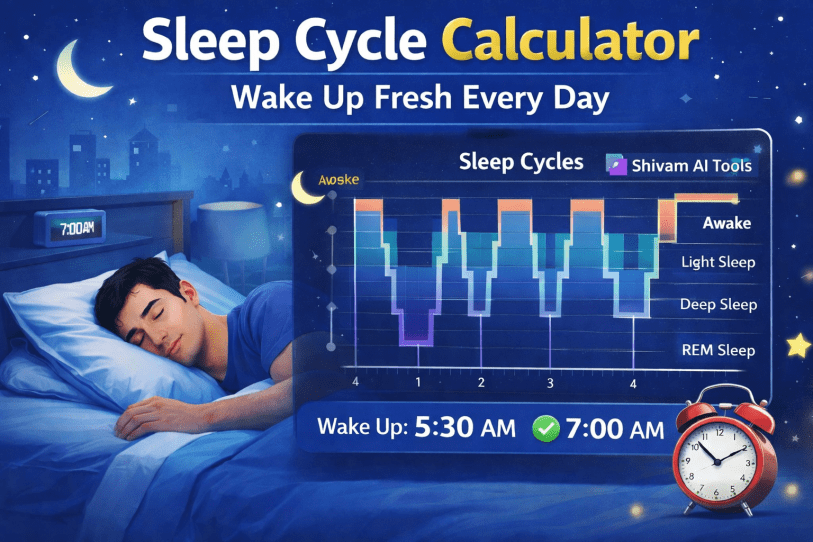
Your brain doesn’t just switch off and restart. It cycles through stages roughly every 90 minutes: light sleep, then deep sleep, then REM (where memory gets filed and dreams happen).
Interrupt that loop during deep sleep and your brain surfaces slowly, like it’s being dragged up through mud. Catch it at the end of a cycle and you pop awake.
How a sleep calculator works
It counts backward in 90-minute blocks from your target wake time.
Say you need to be up at 6:30 AM. Five cycles back (7.5 hours) puts bedtime at 11:00 PM. Six cycles (9 hours) puts it at 9:30 PM. Four cycles (6 hours): 12:30 AM.
Now add 14 minutes for sleep onset (the average, per sleep research), and your real bedtime for a 6:30 AM alarm becomes 10:46 PM or 12:16 AM. Not “around 11.”
Most adults run best on 5 or 6 complete cycles. That’s 7.5 to 9 hours.
8 hours is 5.33 cycles. You’d wake up 27 minutes into a new one, mid-loop, groggy.
7.5 hours is 5 complete cycles. Cleaner exit. Most people report it beats the extra 30 minutes almost every time.
Pick the number divisible by 90. Sleep math cares about cycle count, not clock hours.
Wake time. Minus 90 minutes per cycle. Plus 15 minutes to fall asleep.
For 7:00 AM wake-up:
- 6 cycles (9 hrs): bed by 9:45 PM
- 5 cycles (7.5 hrs): bed by 11:15 PM
- 4 cycles (6 hrs): bed by 12:45 AM (rough, but survivable)
That’s the whole calculator. No app required.
A few are worth knowing.
Sleepio is a sleep coach that builds a behavioral picture over 6 weeks of diary entries. It sharpens its recommendations the longer you use it, so night 42 gets better advice than night 1. It’s built on CBT-I (Cognitive Behavioral Therapy for Insomnia), the only sleep intervention that’s been shown in randomized trials to work as well as sleeping pills, without the pills.
Rise Science calculates your running sleep debt and maps your energy peaks against your circadian rhythm. It tells you when your focus window hits its ceiling (usually 1 to 3 hours after waking) and flags your natural nap window (early afternoon, 1 to 3 PM for most people). It’s less about bedtime math and more about using your biology as a schedule.
will run the 90-minute cycle math in seconds if you type in your wake time and how many cycles you want. Faster than downloading an app.
None of these AI tools do anything magic. They’re just doing arithmetic you’d do anyway, consistently, without you having to remember to.
Early cycles in the night pack in the most deep sleep. Late cycles are mostly REM. Shorten your night and you’re shaving off the REM phase, the one that consolidates memory and stabilizes mood.
So if you have to sacrifice sleep, do it from the front. Sleep later, not wake earlier.
Cut 90 minutes off the back of your night and you lose a full REM cycle. Cut 90 minutes off the front and you mostly lose some early light sleep. The math is asymmetric and almost nobody knows it.
One thing worth tracking
Consistency of wake time matters more than consistency of bedtime, according to Matthew Walker’s sleep lab research at UC Berkeley. Your body anchors its circadian rhythm to when you wake, not when you sleep.
So pick a wake time and hold it. Even weekends. Even after a late night. The bedtime floats; the wake time is the anchor.
Pick your wake time. Count back in 90-minute blocks. Add 15 minutes. Set one alarm.
Run this for 4 nights. By night 3, you’ll feel the difference in how you surface.
Sleep cycle calculator
frequently asked questions
A sleep calculator figures out when to go to bed (or wake up) by counting backward or forward in 90-minute blocks. Each sleep cycle runs about 90 minutes. The goal is to land your wake time at the end of a cycle, so you surface naturally instead of mid-loop.
5 to 6 for most adults. That's 7.5 to 9 hours. Under 4 cycles (6 hours) consistently and you start stacking sleep debt that compounds faster than most people expect.
It works less well. The calculator finds the right window, but your circadian rhythm anchors to a consistent wake time. Variable bedtimes are manageable. Variable wake times are what destabilize the whole system. Hold the morning alarm steady and let the evening end when it ends.
For 5 cycles: in bed by 10:15 PM (you need to fall asleep by 10:30 PM; subtract 15 minutes for onset). For 6 cycles: in bed by 8:45 PM. For 4 cycles: in bed by 11:45 PM.
Most people find 5 cycles is the workable sweet spot.
Pick a wake time. Hold it for 7 days regardless of when you fall asleep. Skip naps. By day 4 or 5 your body starts pulling you toward sleep earlier on its own. The first 3 days are uncomfortable. Do it anyway.

Shivam AI Tools provides simple, fast, and reliable online calculators to help users plan better and make informed decisions. Our tools are designed for ease of use and educational purposes only
Our Services Tools
Our Services Tools
Contact Us
Best Development Company Shivam Software Raipur Chhattisgarh
+91 9669251442
shivampandey22798@gmail.com